
- About
- Curriculum Audit
- Availability
Students will discover the world of Nanotechnology and Nanomaterials and their use in commercial and biomedical applications.
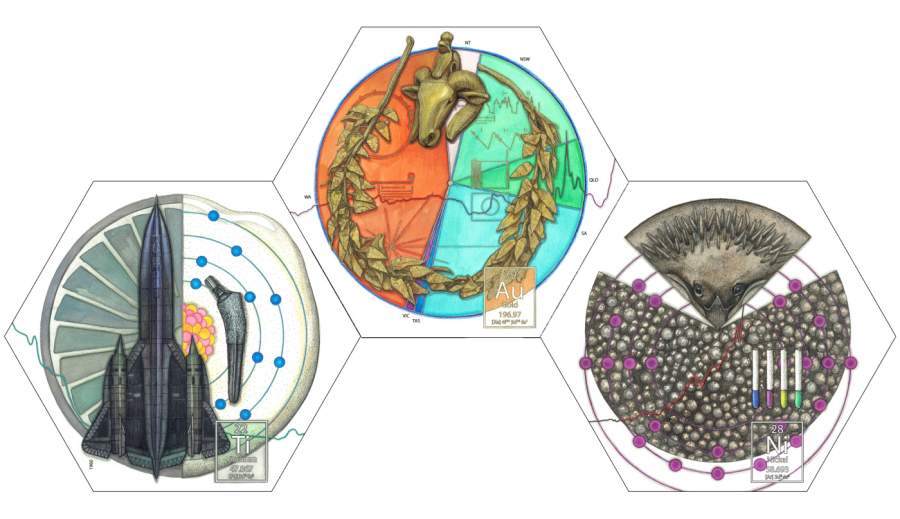
Shape-Memory Alloys are metals that can be pre-programmed to return to a specific shape when they reach their activation temperature. When cool, they are malleable and can be shaped like a typical metal.
Students will investigate the properties of Nanomaterials and Nanofluids and interrogate fundamental principles via experimentation and the incredibly engaging Amazing Race format.
Students will engage in multiple experiments and demonstrations using the Shape Memory Alloy Nitinol including the Clean Water Engine, the Biomechanical Inchworm and Green Energy Windmills. They will take part in an extended investigation into the load bearing capacity of Shape Memory Alloys and their use as construction materials.
Curriculum Audit
-
Level 7
-
Critical and Creative Thinking
-
Meta-cognition
- Consider a range of strategies to represent ideas and explain and justify thinking processes to others (VCCCTM040)
-
Questions and Possibilities
- Synthesise information from multiple sources and use lateral thinking techniques to draw parallels between known and new solutions and ideas when creating original proposals and artefacts (VCCCTQ034)
-
Reasoning
- Examine common reasoning errors including circular arguments and cause and effect fallacies (VCCCTR035)
-
Meta-cognition
-
Science
-
Science Inquiry Skills
-
Questioning and predicting
- Identify questions, problems and claims that can be investigated scientifically and make predictions based on scientific knowledge (VCSIS107)
-
Planning and conducting
- In fair tests, measure and control variables, and select equipment to collect data with accuracy appropriate to the task (VCSIS109)
-
Analysing and Evaluating
- Use scientific knowledge and findings from investigations to identify relationships, evaluate claims and draw conclusions (VCSIS111)
- Reflect on the method used to investigate a question or solve a problem, including evaluating the quality of the data collected, and identify improvements to the method (VCSIS112)
-
Recording and processing
- Construct and use a range of representations including graphs, keys and models to record and summarise data from students' own investigations and secondary sources, and to represent and analyse patterns and relationships (VCSIS110)
-
Communicating
- Communicate ideas, findings and solutions to problems including identifying impacts and limitations of conclusions and using appropriate scientific language and representations (VCSIS113)
-
Questioning and predicting
-
Science Understanding
-
Chemical sciences
- The properties of the different states of matter can be explained in terms of the motion and arrangement of particles (VCSSU096)
- Differences between elements, compounds and mixtures can be described by using a particle model (VCSSU097)
- Chemical change involves substances reacting to form new substances (VCSSU098)
-
Earth and space sciences
- Some of Earth's resources are renewable, but others are non-renewable (VCSSU100)
-
Physical Sciences
- Energy appears in different forms including movement (kinetic energy), heat, light, chemical energy and potential energy; devices can change energy from one form to another (VCSSU104)
-
Science as a Human Endeavour
- Science and technology contribute to finding solutions to a range of contemporary issues; these solutions may impact on other areas of society and involve ethical considerations (VCSSU090)
-
Chemical sciences
-
Science Inquiry Skills
-
Critical and Creative Thinking
-
Level 8
-
Critical and Creative Thinking
-
Meta-cognition
- Consider a range of strategies to represent ideas and explain and justify thinking processes to others (VCCCTM040)
-
Questions and Possibilities
- Synthesise information from multiple sources and use lateral thinking techniques to draw parallels between known and new solutions and ideas when creating original proposals and artefacts (VCCCTQ034)
-
Reasoning
- Examine common reasoning errors including circular arguments and cause and effect fallacies (VCCCTR035)
-
Meta-cognition
-
Mathematics
- Number and Algebra
-
Statistics and Probability
-
Data Representation and Interpretation
- Explore the variation of means and proportions of random samples drawn from the same population (VCMSP299)
-
Data Representation and Interpretation
-
Science
-
Science Inquiry Skills
-
Questioning and predicting
- Identify questions, problems and claims that can be investigated scientifically and make predictions based on scientific knowledge (VCSIS107)
-
Planning and conducting
- In fair tests, measure and control variables, and select equipment to collect data with accuracy appropriate to the task (VCSIS109)
-
Analysing and Evaluating
- Use scientific knowledge and findings from investigations to identify relationships, evaluate claims and draw conclusions (VCSIS111)
- Reflect on the method used to investigate a question or solve a problem, including evaluating the quality of the data collected, and identify improvements to the method (VCSIS112)
-
Recording and processing
- Construct and use a range of representations including graphs, keys and models to record and summarise data from students' own investigations and secondary sources, and to represent and analyse patterns and relationships (VCSIS110)
-
Communicating
- Communicate ideas, findings and solutions to problems including identifying impacts and limitations of conclusions and using appropriate scientific language and representations (VCSIS113)
-
Questioning and predicting
-
Science Understanding
-
Chemical sciences
- The properties of the different states of matter can be explained in terms of the motion and arrangement of particles (VCSSU096)
- Differences between elements, compounds and mixtures can be described by using a particle model (VCSSU097)
- Chemical change involves substances reacting to form new substances (VCSSU098)
-
Earth and space sciences
- Some of Earth's resources are renewable, but others are non-renewable (VCSSU100)
-
Physical Sciences
- Energy appears in different forms including movement (kinetic energy), heat, light, chemical energy and potential energy; devices can change energy from one form to another (VCSSU104)
-
Science as a Human Endeavour
- Science and technology contribute to finding solutions to a range of contemporary issues; these solutions may impact on other areas of society and involve ethical considerations (VCSSU090)
-
Chemical sciences
-
Science Inquiry Skills
-
Critical and Creative Thinking
-
Level 9
-
Critical and Creative Thinking
-
Meta-cognition
- Investigate how the use of a range of learning strategies can be monitored, evaluated and re-directed as necessary (VCCCTM052)
- Investigate the kind of criteria that can be used to rationally evaluate the quality of ideas and proposals, including the qualities of viability and workability (VCCCTM053)
-
Questions and Possibilities
- Suspend judgements to allow new possibilities to emerge and investigate how this can broaden ideas and solutions (VCCCTQ044)
- Challenge previously held assumptions and create new links, proposals and artefacts by investigating ideas that provoke shifts in perspectives and cross boundaries to generate ideas and solutions (VCCCTQ045)
-
Meta-cognition
-
Mathematics
-
Number and Algebra
-
Linear and non-linear relationships
- Graph simple non-linear relations with and without the use of digital technologies and solve simple related equations (VCMNA311)
-
Linear and non-linear relationships
-
Number and Algebra
-
Science
-
Science Inquiry Skills
-
Questioning and predicting
- Formulate questions or hypotheses that can be investigated scientifically, including identification of independent, dependent and controlled variables (VCSIS134)
-
Planning and conducting
- Select and use appropriate equipment and technologies to systematically collect and record accurate and reliable data, and use repeat trials to improve accuracy, precision and reliability (VCSIS136)
-
Recording and processing
- Construct and use a range of representations, including graphs, keys, models and formulas, to record and summarise data from students' own investigations and secondary sources, to represent qualitative and quantitative patterns or relationships, and distinguish between discrete and continuous data (VCSIS137)
-
Analysing and Evaluating
- Analyse patterns and trends in data, including describing relationships between variables, identifying inconsistencies in data and sources of uncertainty, and drawing conclusions that are consistent with evidence (VCSIS138)
-
Questioning and predicting
-
Science Understanding
- Science as a Human Endeavour
-
Physical Sciences
- The description and explanation of the motion of objects involves the interaction of forces and the exchange of energy and can be described and predicted using the laws of physics (VCSSU133)
-
Chemical sciences
- All matter is made of atoms which are composed of protons, neutrons and electrons; natural radioactivity arises from the decay of nuclei in atoms (VCSSU122)
- The atomic structure and properties of elements are used to organise them in the periodic table (VCSSU123)
- Chemical reactions involve rearranging atoms to form new substances; during a chemical reaction mass is not created or destroyed (VCSSU124)
-
Science Inquiry Skills
-
Critical and Creative Thinking
-
Level 10
-
Critical and Creative Thinking
-
Meta-cognition
- Investigate how the use of a range of learning strategies can be monitored, evaluated and re-directed as necessary (VCCCTM052)
- Investigate the kind of criteria that can be used to rationally evaluate the quality of ideas and proposals, including the qualities of viability and workability (VCCCTM053)
-
Questions and Possibilities
- Suspend judgements to allow new possibilities to emerge and investigate how this can broaden ideas and solutions (VCCCTQ044)
- Challenge previously held assumptions and create new links, proposals and artefacts by investigating ideas that provoke shifts in perspectives and cross boundaries to generate ideas and solutions (VCCCTQ045)
-
Meta-cognition
-
Science
-
Science Inquiry Skills
-
Questioning and predicting
- Formulate questions or hypotheses that can be investigated scientifically, including identification of independent, dependent and controlled variables (VCSIS134)
-
Planning and conducting
- Select and use appropriate equipment and technologies to systematically collect and record accurate and reliable data, and use repeat trials to improve accuracy, precision and reliability (VCSIS136)
-
Recording and processing
- Construct and use a range of representations, including graphs, keys, models and formulas, to record and summarise data from students' own investigations and secondary sources, to represent qualitative and quantitative patterns or relationships, and distinguish between discrete and continuous data (VCSIS137)
-
Analysing and Evaluating
- Analyse patterns and trends in data, including describing relationships between variables, identifying inconsistencies in data and sources of uncertainty, and drawing conclusions that are consistent with evidence (VCSIS138)
-
Questioning and predicting
-
Science Understanding
- Science as a Human Endeavour
-
Physical Sciences
- The description and explanation of the motion of objects involves the interaction of forces and the exchange of energy and can be described and predicted using the laws of physics (VCSSU133)
-
Chemical sciences
- All matter is made of atoms which are composed of protons, neutrons and electrons; natural radioactivity arises from the decay of nuclei in atoms (VCSSU122)
- The atomic structure and properties of elements are used to organise them in the periodic table (VCSSU123)
- Chemical reactions involve rearranging atoms to form new substances; during a chemical reaction mass is not created or destroyed (VCSSU124)
-
Science Inquiry Skills
-
Critical and Creative Thinking
- Student learning
- Arrival: 10:00am
- Finish: 2:00pm